
2026
June 16th-18th, Grass Valley, California
SCHEDULE OF EVENTS
Tuesday, June 16, 20264:00 pm to 7:00 pm Registration
5:00 pm to 6:30 pm Reception (no-host)
6:30 pm to 9:00 pm Dinner
Wednesday, June 17, 2026
7:00 am to 8:00 am Breakfast
8:00 am to 12:05 pm Welcome and Technical Presentations
12:05 pm to 1:00 pm Lunch
1:00 pm to 5:10 pm Technical Presentations, Evaluations, Remarks
5:45 pm to 11:00 pm Dinner and Networking Session at Scotts Flat Lake Campground, Nevada City
Thursday, June 18, 2026
7:00 am to 8:00 am Breakfast
8:00 am to 12:00 pm Technical Presentations
12:00 pm to 12:20 pm Speaker and Attendee Recognition
12:20 pm to 12:30 pm Concluding Remarks and Evaluations
12:30 pm to End Lunch
Chain-Up Delay Tracking and Estimation for Interstate 5 in Northern California (pdf)
Jeremiah Pearce, Ozair Purmul; Caltrans District 2
Douglas Galarus, Montana Technological University
|
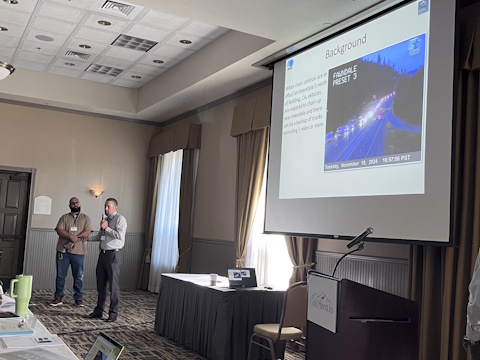
On northbound I-5 north of Redding, CA, when chain controls are in place, trucks are required to chain up near Fawndale, and there can be a backup of trucks for miles approaching and sometimes into Redding. The purpose of this project is to determine accurate delay times that can be displayed on changeable message signs (CMS) before the backup starts to reduce wait times and backup length, and to improve safety within this corridor. Montana Tech researcher Doug Galarus and Caltrans District 2 engineers Jeremiah Pearce and Ozair Purmul discussed the nuts-and-bolts details of what worked, challenges faced, and project results to date. They concluded with comprehensive discussion about their conclusions and next steps. |
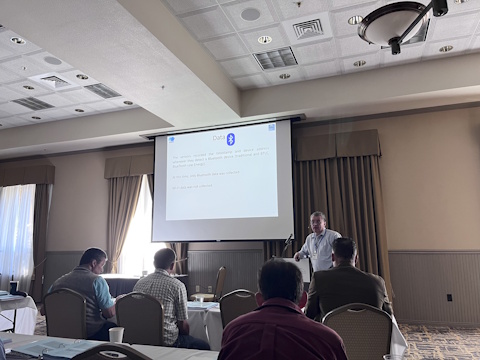
Ozair Purmul (left) and Jeremiah Pearce (right), Caltrans District 2
Photo by Leann Koon
Powering ITS Devices in Challenging Environments (pdf)
Troy Torgersen, Tyson Larson
Utah Department of Transportation, Region 4
|
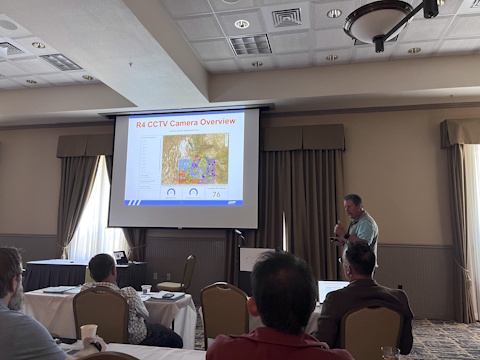
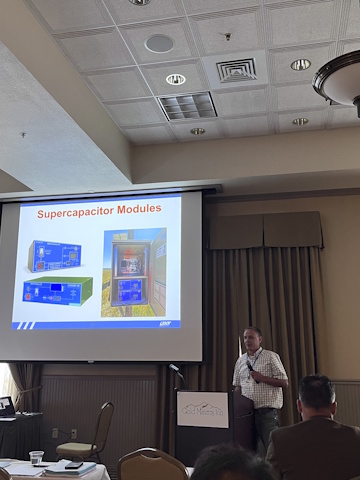
UDOT’s Intelligent Transportation System (ITS) includes traffic cameras, nonintrusive detection devices, Variable Message Signs (VMS), and Traffic Monitoring Systems (TMS), as some examples. When these devices are located off the power grid, they are currently powered by solar panels with battery backup. Equipment deployed in mountainous areas is subject to reduced sunlight and low temperatures which limits the effectiveness and efficiency of current equipment. Troy Torgersen and Tyson Larson from UDOT Region 4 discussed efforts to improve the power supply of ITS devices in remote, mountainous areas. Specifically, they focused on the use of super capacitors as an alternative to batteries. Troy and Tyson explained supercapacitor technology, its use, and features, and compared them to using traditional batteries. They also discussed lessons learned for implementing super capacitors as well as using solar and wind in combination for powering ITS devices in remote and mountainous areas. |
SWR Safepath Wrong Way Systems
Scott Mercer, Dan Huynh
Washington State Department of Transportation
|
The Washington State DOT allocated funds to install multiple wrong way detection systems throughout the state. In a follow-up to the 2023 Forum presentation by Scott Mercer (C-Street Wrong Way Detection System), Scott and colleague Dan Huynh discussed the Southwest Region’s experience with the AM Signal Safepath system. This system integrates Flir IR cameras, Flir’s ITS management software, Trafficalm controller cabinets, Trafficalm warning signs and existing infrastructure where available. Scott and Dan described and discussed the specific combination of equipment implemented, as well as communications, server, software and operations to provide an understanding of what an agency might expect from deploying the Safepath wrong-way system. |
Scott Mercer (left) and Dan Huynh (right), Washington State Department of Transportation
Photo by Doug Galarus
Remote ITS Control & Telemetry Solution (pdf)
Gregg Thompson, Mark Aragon
Nevada Department of Transportation
|
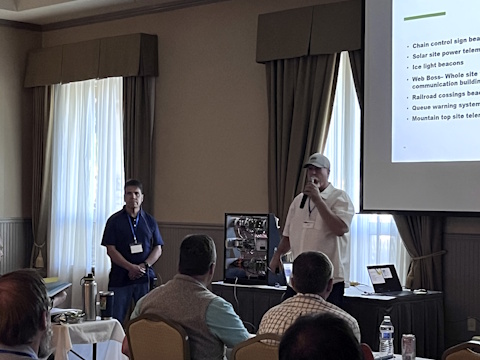
Nevada DOT’s District 3 manages critical safety systems in rural locations. In the past, NDOT staff had to drive several hours to repair and maintain these systems. After considering multiple alternatives, NDOT selected and designed a more cost-effective, off-the-shelf, reliable Web Relay product to remotely monitor and control signs and ITS network devices. Gregg Thompson and Mark Aragon, IT Professionals for traffic operations, communications, and ITS, started at the beginning describing the need and background, and the steps taken to design and implement such a system. They shared technical details on the system’s components and operations and concluded with a demonstration. The system’s equipment was set up in the meeting room for the Forum attendees to view and discuss with Gregg and Mark. |
Mark Aragon (left) and Gregg Thompson (right), Nevada Department of Transportation
Photo by Leann Koon
Smart and Cooperative Truck Parking Information Management System (TPIMS) (pdf)
Nutvara Jantarathaneewat*, Kehua (Zeon) Chen, Yinhai Wang; University of Washington
Matt Neeley, Robert Stull; Washington State Department of Transportation
*speaker
|
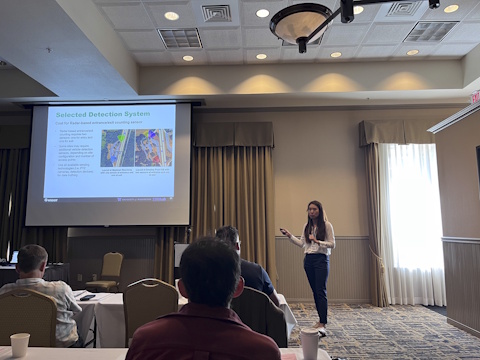
Adequate truck parking availability is a critical component of roadway safety, as insufficient or unreliable parking information can contribute to driver fatigue, illegal roadside parking, and increased crash risk. To address this challenge, the Washington State Department of Transportation (WSDOT) has deployed the Truck Parking Information Management System (TPIMS) across 11 sites along the Interstate 5 (I-5) corridor where parking demand is highly variable and timely parking information is limited. University of Washington graduate student Nutvara Jantarathaneewat began by describing the problem and project motivation. She delved into the system requirements, implementation, and development and deployment of the prediction model. Nutvara discussed the API design and user interface, data quality improvement, and calibration work. She concluded with key findings, lessons learned, future directions, and a system demonstration. |
NDOT Truck Parking Availability System (TPAS) Pilot Project (pdf)
Eric MacGill, Jordan James
Nevada Department of Transportation
|
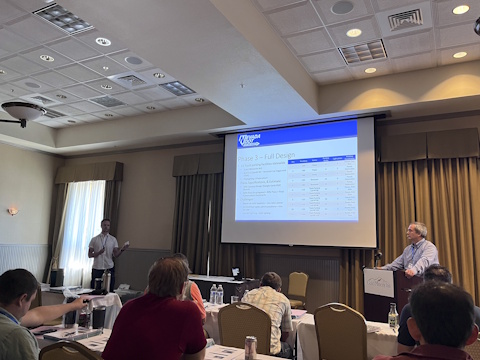
Nevada DOT’s Truck Parking Availability system (TPAS) initiative was launched in response to significant disparities between parking supply and demand. It aims to support regulatory compliance, reduce economic impacts, and enhance roadway safety. Test site project manager Eric MacGill and pilot project manager Jordan James first explained the truck parking challenges Nevada experiences and how the TPAS initiative’s project objectives address those challenges. Eric and Jordan described the results of Phase 1 – Discovery and how those results informed Phase 2 – Test Bed Implementation. They shared results and lessons learned to date on the test beds and explained what’s ahead for the TPAS initiative, including final designs, post-design support, and further coordination and data sharing across state lines. |
Jordan James (left) and Eric MacGill (right), Nevada Department of Transportation
Photo by Leann Koon
ReadyOp: Integrating Communications, Information Sharing and Operations Through Practical Applications (pdf)
Aisha Dayal*, Tony Leingang
Washington State Department of Transportation
*speaker
|
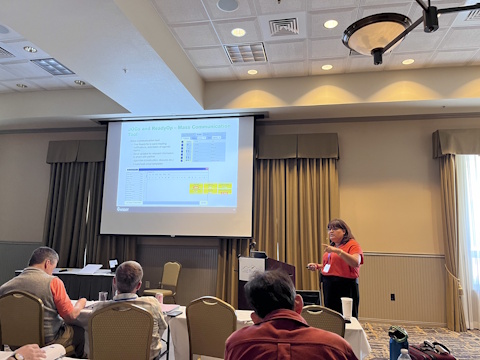
Washington State DOT’s Incident Management Coordinator, Aisha Dayal, discussed their use of the ReadyOp System, which has been part of WSDOT operations since 2014. She began with context for the project and an overview of agency needs, including mass communications, organization and facilitation of Joint Operations Groups, incident tracking and documentation, and emergency alerts and notifications. Aisha detailed how the different stakeholders utilize the ReadyOp system, including integration by the Virtual Coordination Center (VCC) which WSDOT presented at the 2024 Forum. She shared some examples of how WSDOT deployed ReadyOp during large scale incidents (e.g., 2025 flooding) and then demonstrated some of the features of the system. She concluded with discussion about application maintenance, and challenges and next steps for usage and maximum interoperability. During the Forum’s Wednesday evening networking session in an area with limited cell service, Aisha and WSDOT’s State ITS Program Administrator Tony Leingang demonstrated the use of Starlink communications with the ReadyOp application. |
Aisha Dayal, Washington State Department of Transportation
Photo by Leann Koon